










More stable contact with the material
The roller surface must be selected to suit the process: film, paper, textiles, rubber, silicone, or other web materials. A worn or improperly prepared surface can affect material guidance and the final result.
Calender rolls work in direct contact with the material in an industrial production line. This means that performance depends not only on the coating, but also on roll geometry, journal condition, substrate preparation, surface roughness, operating temperature and nip pressure.
For the assessment, please prepare a drawing, dimensions, photos of the roll or a description of how it operates in the machine.
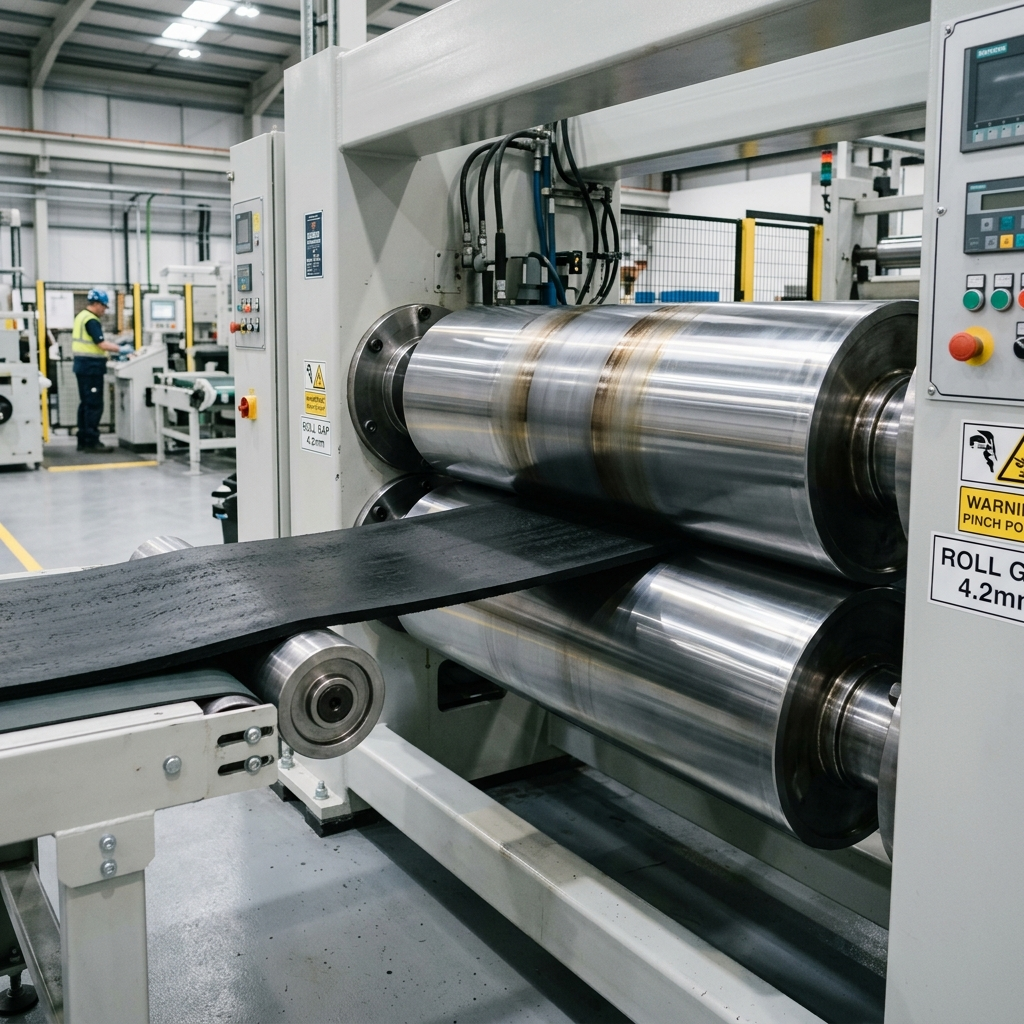
PROEXPORT supplies new calender rolls, reconditions worn rolls and selects working-surface solutions for specific line operating conditions. We determine the scope of work from technical documentation, an existing sample, photographs or an assessment of the current roll.
We manufacture new calender rolls in accordance with the customer’s technical documentation or based on an analysis of the provided sample. The scope of production depends on the geometry, dimensions, journals, and working surface requirements.
Reconditioning may include removing the existing coating, preparing the substrate, applying a new hard chrome coating, final machining, and assessing the working surface, journals and roll geometry.
Hard chrome provides a hard, low-friction and reconditionable working surface. For applications involving different wear conditions, ceramics, WC HVOF, nickel or a multilayer coating system may also be considered.
After applying the coating, we can grind, polish, and—in certain applications—hone the working surface. The goal is to achieve a surface that meets the requirements for the roller’s operation.
Roll reconditioning can include an assessment of the journals, mating surfaces and part geometry. This is important because line problems are not always caused solely by a worn coating.
We analyze whether technical chrome, ceramic, HVOF coating, electroless nickel, or a multi-layer system would be appropriate in a given case. The choice depends on pressure, temperature, abrasion, chemical exposure, and the roller’s operating conditions.
Send us a drawing, photos, dimensions or a description of the roller’s operation — we will assess the feasible scope of work.
We manufacture calender rolls in accordance with technical documentation, a provided sample, or an evaluation of an existing part. The values below show the range of categories and typical parameters for rolls with a working surface made of either chrome and WC HVOF tungsten carbide.
| Part Type | roll or working cylinder for a calender |
|---|---|
| Scope of Service | New Production, Reconditioning and Reproduction from an Existing Sample |
| Basis for Execution | a technical drawing, a provided sample, or a physical part for measurement |
| WORKING SURFACE | hard chrome or tungsten carbide (WC) HVOF — The selection depends on the pressure, the nature of the abrasion, the temperature, the rigidity of the structure, and the expected performance of the material. |
| Hard Chrome | a coating applied by electroplating and then mechanically finished; suitable where low-friction properties, reconditionability and a very smooth working surface are important |
| Tungsten Carbide (WC) HVOF | An option to consider for applications with higher abrasive wear and greater process loads; the scope of manufacture and final machining must be confirmed based on the documentation and operating conditions of the roller |
| Hard Chrome Coating Thickness | typically 10–200 µm; thicker coatings are available only subject to an individual quotation |
| Hard Chrome Hardness | 850–1200 HV |
| Roughness after polishing chrome | typically Ra 0.08–0.16 µm |
| Precision Surfaces | In certain applications, Ra < 0.08 µm is possible, following an analysis of the part's requirements |
| Hard Chrome Operating Temperature | Full properties up to approx. 200°C; usable up to approx. 400°C with decreasing hardness |
| Finishing | grinding, polishing, or honing the working surface—the scope depends on the coating, documentation, and the desired surface finish |
| Special Design Options | heating channels, drilled passages and non-standard journals — scope confirmed after reviewing the documentation |
| Data for evaluation | drawing, photos, dimensions, current coating, information on whether technical chrome or WC HVOF is being considered, and a description of the roller’s operation in the machine |
We confirm the final production specifications after reviewing the documentation, inspecting the roller, or examining the provided sample. The same symptom—such as scratches or rapid surface wear—may be caused by the coating, the geometry, the condition of the pins, or the operating conditions on the production line. On this page, we discuss only technical chromium and WC HVOF tungsten carbide.
A properly selected calender roll helps maintain consistent contact with the material. In practice, the working surface, substrate load capacity, abrasion resistance, dimensional stability and roll performance under pressure are important.
The roller surface must be selected to suit the process: film, paper, textiles, rubber, silicone, or other web materials. A worn or improperly prepared surface can affect material guidance and the final result.
Scratches, sticking, uneven gloss, or marks left by the roller may be caused by the work surface. That is why, when we receive an inquiry, we analyze not only the coating but also the operating conditions and the expected outcome of the process.
Industrial-grade chromium is well-suited as a hard, low-friction, and renewable coating. For applications involving different types of wear, WC HVOF or a multi-layer coating system may also be considered.
In many cases, a worn roller does not necessarily have to be replaced with a new one. If the metal part is still serviceable, it is possible to remove the old coating, prepare the substrate, and apply a new working layer.
If the customer does not have complete documentation, the physical roller can serve as a starting point for evaluating its dimensions and geometry. This shortens the path from a production line problem to a decision: reconditioning, a new roller, or a coating change.
Send us a drawing, photos, dimensions, or a description of the roller—we’ll assess whether refurbishment, a new unit, or a coating replacement would be the best option.
Calender rolls operate in lines where the material passes through a roll assembly under pressure, heat, or a specific surface contact. In each industry, different parameters will be critical.
In film production lines, surface smoothness, sliding properties, stable heat dissipation, and reduced material adhesion are important.
When used with paper and cardboard, the roller may be exposed to moisture, abrasion, and pressure. In your inquiry, please describe the operating environment and any existing damage.
In textiles, what matters is stable geometry and a surface that does not cause fibers to snag. When working with heat, one must take into account the behavior of technical chromium or tungsten carbide.
In printing, surface precision and consistent contact with the material are of great importance. In certain applications, very low surface roughness after final processing may be critical.
For rubber, silicone, and special applications, the decision regarding the working surface must be based on data regarding temperature, pressure, material, and the roller’s operating mode.
Please specify the material, temperature, pressure, current damage, and the desired surface finish— based on this information, it will be easier to determine whether technical chrome, tungsten carbide, or the restoration of the existing part is the appropriate solution.
Reconditioning a calender roll makes sense when the metal part can still be used. A worn working surface does not always mean that a new part must be manufactured, but reconditioning itself should not be assumed automatically.
Before reconditioning, the working surface, journals, visible damage, geometry and condition of the roll body must be assessed. Scratches, wear or local damage may indicate a problem with the coating, nip pressure, temperature or roll geometry.
With technical chrome plating, the old coating is removed electrochemically, without eroding the steel substrate. With WC HVOF tungsten carbide, the surface preparation process requires an assessment of the part, documentation, and the condition of the existing coating.
Once the substrate has been prepared, the roller may be selected for technical chrome plating or for the WC HVOF tungsten carbide coating, if operating conditions warrant this approach. The final scope depends on the documentation and the condition of the part.
After the working surface has been machined, the roll undergoes a final finish selected based on the type of coating and process requirements. The goal is to achieve a surface that complies with the documentation and the operating conditions of the roll in the production line.
If the roller wall is too thin, the roller body has lost its geometry, or the mechanical damage is too severe, it may be more appropriate to manufacture a new roller. The decision depends on the condition of the part, the process requirements, and whether the roller will have sufficient rigidity for continued operation after reconditioning.
Send photos of the working surface and journals, together with the basic dimensions and a description of the problem. Based on this information, we can make a preliminary assessment of the appropriate course of action: reconditioning, manufacturing a new roll, hard chrome plating or a WC HVOF tungsten carbide coating.
The decision between remanufacturing and purchasing a new roller does not depend solely on cost. What matters more is whether the remanufactured part will be technically capable of operating under the current line conditions.
If the roll body, journals and geometry allow continued operation, reconditioning may reduce the need to manufacture the entire component from scratch.
In this case, the working surface is restored and, where necessary, mechanical work is also performed on the metal part.
A new roll should be considered when wear is not limited to the working surface. Potential problems include an excessively thin wall, loss of geometry or serious journal damage.
A new design may also be more appropriate if the operating conditions of the line have changed and the existing solution no longer meets the requirements for pressure, temperature, or the nature of the abrasion.
If the same symptoms return after successive reconditioning processes—scratches, material sticking, rapid wear or web-guiding problems—it is necessary to check whether the current working surface is suitable for the process.
In that case, the analysis may indicate that repeating the same reconditioning process is not appropriate and that a different working-surface solution should be considered.
Send us the technical specifications or photos of the part—we’ll assess the possible options: remanufacturing, new fabrication, geometry restoration, technical chrome plating, or WC HVOF tungsten carbide.
Collaboration regarding the calender roll should not be reduced to a simple question about the price of chrome plating. It is important to identify the problem, select the appropriate work surface, and inspect the part before shipment.
We analyze whether the problem results from surface wear, journal condition, geometry, operation of the roll in the machine, temperature, pressure or an incorrectly selected working surface.
We base the selection of the working surface on the process conditions: pressure, the nature of abrasion, temperature, structural rigidity, expected surface finish, and the possibility of subsequent regeneration. This page discusses two options: technical chrome and WC HVOF tungsten carbide.
We can analyze whether it would be appropriate to repair the existing part, restore its geometry, or manufacture a new cylinder. This reduces the need to split the issue into several separate requests.
The absence of a technical drawing does not have to halt the project. If a physical cylinder is available, it is possible to assess whether the dimensions and geometry can be reproduced based on the part.
For rollers made of technical chrome or tungsten carbide, it is important to perform a final inspection of the working surface and to protect the workpiece. The scope of the inspection depends on the documentation, the type of surface, and the operational requirements of the roller.
When it comes to calender rolls, simply knowing the worn surface area is often not enough. To provide an accurate recommendation, we need data on the material, temperature, pressure, the current working surface, the condition of the roll journals, and the symptoms of the problem.
Send us a drawing, photos, dimensions, or a description of the roller’s operation—we’ll organize the data and suggest possible options: refurbishment, a new unit, technical chrome, or WC HVOF tungsten carbide.
When ordering a new calender roll or planning a refurbishment, the most common questions concern documentation, selection of the working surface, surface roughness, operating temperature, and the ability to reproduce the part based on a sample. Below, we have compiled a list of issues that are worth clarifying before sending an inquiry.
When it comes to calender rolls, simply knowing the type of coating is not enough. The results are influenced by substrate preparation, the structure of the technical chrome, surface roughness, temperature, the operating environment, and the method of contact with the material.
The quality of the final surface does not depend solely on the chrome plating process itself. The type of steel, the condition of the substrate, surface preparation, and grinding prior to coating application are all important factors. Errors at this stage can affect the coating’s adhesion, durability, and performance on the production line.
Technical chrome has a natural network of microcracks. This is not necessarily a defect. In a properly applied coating, this structure can enhance lubricity and the retention of the process medium. However, it is important to distinguish between a normal microstructure and wide cracks resulting from a process error or overheating.
Hard chrome hardness is specified in HV and should not be determined from an isolated HRC measurement taken on a thin coating. Typical hardness ranges from 850 to 1200 HV. Ra roughness describes the effect of the final finish, and the operating temperature affects the coating’s performance: full properties up to about 200°C, and operation up to about 400°C with decreasing hardness.
Industrial chrome should not be regarded as unconditional protection against corrosion. The coating provides protection as long as it is properly selected, applied, and undamaged.In more demanding environments, an intermediate nickel layer or another multilayer coating system may need to be considered.
Before starting a technical discussion, prepare a drawing, dimensions, photos of the roller, or a description of the machine’s operation. The most important factors are: diameter, length, surface condition, condition of the journals, current working surface, operating temperature, material being processed by the roller, and the nature of the problem.
Based on this, we can assess the possible course of action: a new part, remanufacturing, geometric restoration, technical chrome plating, or WC HVOF tungsten carbide.
Send a Drawing, Dimensions or Photos of the Roll → For a preliminary assessment, documentation, photos, or a basic description of the roller's operation on the line are sufficient.a technical drawing or photos of the roller,
the diameter, length, and approximate weight of the part,
photos of the working surface and journals,
information on whether the surface is currently treated with technical chrome, HVOF, or another type of wear-resistant coating,
a description of the temperature, pressure, material, and symptoms of the problem.
PROEXPORT manufactures and reconditions industrial rolls for production lines. We confirm the scope of each calender roll after reviewing the documentation, assessing the condition of the part or examining the supplied sample.