Comparison of Technical Coatings

Technical chrome or technical ceramics? How to choose a roller coating

The choice of roller coating should not be based solely on hardness. First, you need to determine what is damaging the surface: abrasion, chemicals, pressure, impacts, temperature, the medium, or the condition of the substrate.

Technical chrome is ideal for applications where low friction, point load, impact resistance, and wear resistance are important,

Engineering ceramics have an advantage when it comes to uniform wear, chemical corrosion, and contact with liquids,

The decision should be based on the roller's operating conditions, not on the principle that „harder is better.”.

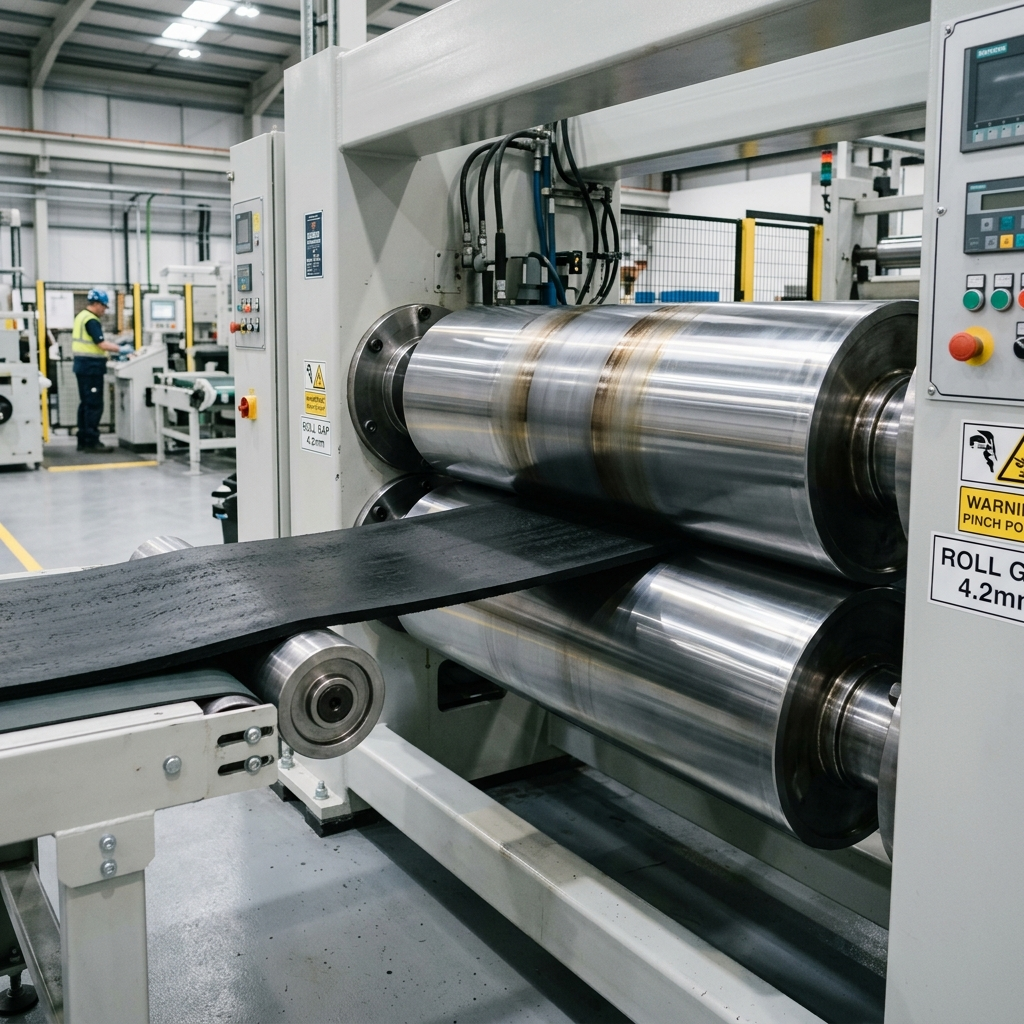
Industrial rollers in a calendering line for comparing chrome and ceramic coatings
Selection of Roller Coating

It's not about which coating is better

Engineering chrome and engineering ceramics address various operational issues. In practice, the choice is determined not by a single parameter, but by the roller’s operating conditions: contact pressure, impact resistance, working medium, temperature, wear pattern, and substrate condition.

The coating performs in the machine, not in the specifications table

Technical chrome or technical ceramics — This question usually comes up when the roller wears out too quickly, scratches the material, corrodes, or causes the line to operate erratically. The hardness rating alone is not enough to make a good decision.

Chromium may be more advantageous in applications where low friction, resistance to point loading, impact resistance, and the ability to regenerate. Ceramics may have an advantage in cases of uniform abrasion, chemical aggression, and operation with liquids—provided the application does not generate high point loads.

First, the wear mechanism; then, the choice of coating.

A good decision starts with determining what is actually damaging the roller surface: abrasion, chemicals, media adhesion, corrosion, pressure, impacts, or a damaged substrate.

Hard Chrome

850–1,200 HV

A range typical for technical chrome. Friction, impact resistance, point load, and the coating's regenerability are also important.

Cr₂O₃ / Al₂O₃ Ceramics

1,200–1,800 HV

Higher hardness helps with uniform wear, but does not automatically mean a longer service life in every application.

Technical Decision

Working Conditions

The selection is determined by the medium, temperature, pressure, impact, bending, the roller's geometry, and the condition of the base surface.

Starting Point

Why is the question „chrome or ceramic” too simple?

When comparing technical coatings, one shouldn't start by looking for a single winner. Technical chrome and technical ceramics have different strengths, which is why the same coating may perform very well in one application and poorly in another.

The coating is used in a specific machine

A roller in a coating, paper, film, or printing line is subjected to different loads. What matters is medium, pressure, temperature, speed, and method of contact with the material.

Hardness alone is not enough to make a decision

Technical ceramics are usually harder than chrome, but that doesn't mean they will always be more durable. When impact, point load, or bending A more brittle coating can be risky.

A symptom does not always indicate the cause

Scratches, corrosion, media buildup, or rapid wear can have various causes. The cause may be coating, substrate, roller geometry, operating conditions, or process medium.

The most important conclusion

Ceramic isn't „better than chrome”

This is a different coating for different operating conditions. The choice between technical chrome and technical ceramic should be based on how the roller wears down in a specific machine.

What needs to be determined before making a comparison?

  • What is the mechanism of wear: Abrasion, chemicals, pressure, impact, or corrosion?
  • How a roller works: with liquid, dry material, plastic wrap, paper, varnish, or glue?
  • What are the loads: Point load, bending, temperature, and operating speed?
  • What is the condition of the ground like: core, geometry, pins, and base surface?
Hard Chrome

Where is industrial chrome used?

Technical chrome is a functional working coating, not a decorative finish. In industrial rollers, what matters most is its hardness, low coefficient of friction, wear resistance, and the ability to regenerate the surface.

Low friction and sliding motion

Industrial-grade chrome is a good choice when the roller surface needs to guide the material with as little friction as possible. This is important, among other things, when working with film, paper, and materials prone to sticking or scratching.

Point loads and mechanical loads

In applications involving point loads, impact risks, or bending stresses, technical chrome may be a safer choice than more brittle ceramics.

Restoration of a worn surface

Chrome plating can be removed and reapplied if the condition of the roller core allows it. This is important for rollers whose bodies are expensive or custom-made for a specific machine.

Conditional corrosion protection

Chromium can protect the steel substrate from corrosion, but only as long as the coating remains intact. If there are cracks, pitting, or mechanical damage, the medium can reach the substrate.

*Temperature is not a simple „yes or no” threshold.

The properties of technical chromium remain stable up to approximately 200°C. When operating at temperatures up to approximately 400°C, its hardness gradually decreases; therefore, the temperature must always be evaluated in conjunction with the load, friction, and the roller’s operating conditions.

Technical Ceramics

Where does technical ceramics have an advantage?

Technical ceramics, such as Cr₂O₃ or Al₂O₃, applied using plasma spraying, may be a good solution when the roller is subjected to steady-state abrasion, contact with liquids, or a chemically demanding environment.

Uniform surface wear

Engineered ceramics are well-suited for applications in which the roller wears down evenly across its working surface, without heavy impacts or localized overloading of the coating.

Working with liquids or chemical media

In lines where a roller dispenses or conveys a process medium, the surface's resistance to contact with liquids, varnish, paint, or other process media is important.

Scratch resistance

In scratch-sensitive applications, ceramic can help minimize damage to the work surface. This requires proper application: no impacts, no excessive point loads, and no overloading of the substrate.

An alternative in select apps

Ceramics can be considered as an alternative to technical chromium in cases where a facility wishes to reduce its reliance on electroplating processes based on Cr(VI) compounds, but only if operating conditions permit it.

The most significant limitation: the fragility of the coating

Technical ceramics are hard, but more brittle than chrome. Therefore, when subjected to impacts, high bending stresses, and point loads, decisions must be made with caution. Under such conditions, higher hardness alone is not a sufficient argument.

PROEXPORT Ceramic Coatings

For applications where the use of ceramics is technically justified, check ceramic coatings applied by plasma spraying.

Comparison Table

Technical Chromium vs. Technical Ceramics — A Comparison Without Simplifications

The table helps clarify the differences between coatings, but it does not replace an application analysis. The choice depends on the roller’s wear mechanism: abrasion, pressure, impact, bending, the working medium, temperature, and the condition of the substrate.

Hard Chrome

850–1,200 HV

A good balance of hardness, low friction, resistance to mechanical stress, and the ability to regenerate the surface.

Cr₂O₃ / Al₂O₃ Ceramics

1,200–1,800 HV

Higher hardness and good resistance to steady-state wear, but greater susceptibility to impact, bending, and point loads.

Technical Proposal

Not just HV

Hardness alone does not determine the durability of a roller. The substrate, geometry, the nature of contact with the material, and the loads during the process are also important.

Comparison of Coatings Under Roller Operating Conditions

The table shows which criteria are important in actual roller operation, not just in the specifications table.

Criterion Hard Chrome Technical Ceramics How does this work in practice?
Hardness 850–1,200 HV
The inherent hardness of the chrome coating, expressed on the Vickers scale.
1,200–1,800 HV
Higher hardness, typical of Cr₂O₃/Al₂O₃ ceramic coatings.
Greater hardness does not automatically mean a better choice. You need to consider the pressure, impact resistance, bending, and the surface on which the roller operates.
Abrasion resistance Good wear resistance in many industrial applications, especially where a low coefficient of friction is also important. Works very well for uniform abrasion of the work surface, without impacts or excessive localized pressure. When wear is even, ceramic may have the advantage. When impacts and localized overloads come into play, you need to be careful.
Friction and Slippage the strength of chrome
A low coefficient of friction helps with sliding motion, material handling, and reducing sticking.
It can be used in conveying or metering applications, but the choice depends on the medium, surface roughness, and method of contact. When it comes to sliding friction, chrome is often a safe choice, especially when the coating is to be reapplied later.
Hits It withstands shock waves better than ceramic coatings. It is hard, but more brittle, so impacts are a significant limitation. If impacts, collisions, or foreign objects getting caught between the rollers occur during the process, the ceramic must be carefully evaluated.
Point pressure It may be more advantageous for localized surface loads, provided that the roller's base has sufficient load-bearing capacity. Excessive pressure at a single point increases the risk of cracking or damaging the coating. A hard coating alone is not enough if the roller core or geometry cannot withstand the loads.
Bending stresses It's better to use this direction where the roller is under load and may bend. It does not withstand high bending stresses as well due to the brittleness of the coating. For long or heavily loaded rollers, it is necessary to evaluate not only the coating but also the stiffness of the entire component.
Working with Liquids and Chemicals It can operate in demanding environments, but corrosion protection is limited and depends on the condition of the coating. It may offer advantages when working with liquids, varnish, paint, or chemical media, provided that the application does not generate impacts or localized pressure. This is one of the areas where technical ceramics are often worth examining.
Corrosion It protects the steel substrate only as long as the coating remains undamaged. Once damaged, the medium can reach the substrate through microcracks. It may be advantageous in certain chemically demanding environments, but the choice depends on the medium and the operating conditions. It’s not worth treating any coating as unconditional protection. What matters is the whole package: the coating, the substrate, the seal, and how it’s used.
Refurbishment easier recovery
Worn chrome can be removed and reapplied if the condition of the core allows it.
The restoration or reapplication of a coating requires a case-by-case technical assessment. For expensive rollers or those custom-made for a specific machine, the ability to be remanufactured is often a key argument in favor of chrome.
Cr(VI) and regulations Electrolytic chromium plating is an electroplating process based on chromium compounds. Ceramics can reduce dependence on Cr(VI)-based electroplating processes, but only if operating conditions allow for the use of a ceramic coating. Environmental or regulatory considerations should not replace a technical analysis of the application.

How do I use this table?

The table provides guidance on decision-making, but it is not an automatic tool for selecting a coating. For a real roller, the wear mechanism must be evaluated in relation to the load, the medium, the temperature, the geometry, and the condition of the base surface.

The selection requires data from the process

Photos showing wear, basic dimensions, a description of the medium, and information on how the roller operates in the machine are helpful for evaluation.

Consult with us about coating selection
Selection errors

The Most Common Mistakes When Choosing a Roller Coating

A poorly chosen lining is usually not the result of a single incorrect parameter. The problem arises when a decision is made without analyzing the wear pattern, the medium, the pressure, the temperature, and the condition of the roller itself.

Selection based solely on hardness

Ceramic is harder than chrome, but the HV value alone does not determine the roller's durability. When subjected to impacts, bending, or point loads, a more brittle coating may perform less well.

Omission of the core condition and geometry

The coating works on the substrate. If the core is worn out, the roller has runout, the pins are damaged, or the base surface has not been properly prepared, simply replacing the coating will not solve the problem.

Change in technology not due to wear and tear

Replacing chrome with ceramic only makes sense if it addresses the actual mechanism of wear. If the problem is overload, impact, or poor geometry, the new coating may cause the same issue to recur.

Treating Cr(VI) as the sole criterion

Reducing reliance on electroplating processes can be an important consideration, but it should not replace a technical evaluation. Ceramics are a good option only if the roller’s operating conditions allow for it.

Practical Implications

Don't start with the shell. Start with the wear mechanism.

Scratches, corrosion, media adhesion, or rapid wear are symptoms. Before selecting chrome or ceramic, you must determine what is causing the symptom: the material, the load, the chemistry, the temperature, the geometry, or the condition of the roller.

What should you check before making a choice?

  • Nature of wear: uniform wear, scratches, localized damage, chips, or corrosion.
  • Working medium: film, paper, varnish, paint, glue, liquid, or a chemical medium.
  • Loads: point load, impact, bending, temperature, and operating speed.
  • Cylinder condition: core, journals, bearings, runout, geometry, and previous coating.
  • Purpose of the change: longer service life, less scratching, chemical resistance, regeneration, or reduction of the electroplating process.
A real-world example

Paint-Dispensing Roller: When Did Ceramics Make Sense?

In one of its coating applications, PROEXPORT recommended a ceramic coating instead of technical chrome. The decision was not based on hardness alone, but on the operating conditions of the roller and the nature of the surface wear.

Why was ceramics chosen for this application?

The roller was used in a painting line as a medium-dispensing component. Key requirements included contact with the liquid, surface scratch resistance, and the coating’s operational stability under conditions of steady-state abrasion.

This application did not involve impacts, high localized stresses, or strong bending stresses. This created conditions under which technical ceramics could safely be considered as an alternative to chromium.

1

A problem on the paint line

The roller surface was exposed to contact with the varnish and the risk of scratches that could affect dosing stability.

2

Conditions favorable for ceramics

The wear was more superficial and uniform, without the loads typical of impact applications.

3

Coating Recommendation

Ceramics were identified as the solution best suited for use with liquids and requiring high scratch resistance.

Summary of the Selection

What does a comparison of technical chrome and ceramics reveal?

The selection of a roller coating should not be based on a single parameter. The safest approach is to start with the operating conditions: the wear mechanism, the medium, contact pressure, temperature, impact resistance, and the condition of the roller itself.

Cr

Hard Chrome

It makes sense in applications where low friction, sliding motion, point contact, impact resistance, bending, and the ability to regenerate the coating are important.

Ce

Technical Ceramics

It is worth considering for applications involving uniform wear, work with liquids, contact with paint or chemical media, and a high risk of scratches.

HV

Hardness isn't everything

Technical chrome typically reaches 850–1,200 HV, while Cr₂O₃/Al₂O₃ ceramics reach approximately 1,200–1,800 HV. The HV value alone does not determine the roller’s durability.

VI

Cr(VI) is one of the arguments

Ceramics can reduce dependence on electroplating processes based on Cr(VI), but only if operating conditions allow for their use.

The Safest Route

First the diagnosis, then the coating

In one application, chrome may be the better choice; in another, ceramic; and sometimes the most sensible option is to refurbish a proven solution. The decision should be based on the actual operating conditions of the roller, not simply on a comparison of hardness.

Consult with us about coating selection

Data needed for the assessment

  • working medium: varnish, adhesive, paint, liquid, paper, film, or other process medium,
  • Nature of wear: uniform wear, scratches, chips, corrosion, or localized damage,
  • loads: point load, impact, bending, temperature, and operating speed,
  • cylinder condition: core, journals, geometry, runout, previous coating, and the possibility of reconditioning.
FAQ

Technical Chromium or Technical Ceramics — Technical Questions

The most common questions concern not the coating itself, but the operating conditions of the roller: abrasion, pressure, medium, temperature, regeneration, and material limitations.

Do you need an evaluation of a specific roller?

For a preliminary analysis, photos showing wear, basic dimensions, a description of the medium, and information on how the roller operates in the machine are sufficient.

Submit data for evaluation
Is technical ceramics better than technical chrome?

Not in every application. Ceramics have higher hardness and may perform better under conditions of uniform abrasion, exposure to liquids, or chemical attack. Technical chrome may be more advantageous under point loads, impacts, bending, low friction, and the need for coating regeneration.

Does a higher hardness of the ceramic mean a longer service life for the roller?

Hardness alone does not determine durability. Technical chrome typically has 850–1,200 HV, and Cr₂O₃/Al₂O₃ ceramics, approximately 1,200–1,800 HV. If the application involves impacts, point loads, or bending, a more brittle ceramic may not be the best choice, despite its higher hardness.

When is it better to choose industrial-grade chrome?

Technical chrome is worth considering when the roller operates under sliding friction, feeds material, is exposed to point loads, or requires subsequent regeneration. It is also a common choice where resistance to mechanical loads and the ability to restore the surface are important.

When should you consider a ceramic coating?

A ceramic coating is useful in cases of uniform wear, work with liquids, varnish, paint, or chemical media. However, it must be confirmed that the application does not generate heavy impacts, point loads, or strong bending stresses, since ceramic is harder but more brittle.

Does ceramic technology address the issue of Cr(VI)?

Ceramics can reduce reliance on electroplating processes based on Cr(VI), but only in applications where operating conditions allow for the use of a ceramic coating. Regulatory considerations should not replace a technical analysis of the roller.

Does technical chrome protect the roller from corrosion?

Electrolytic chromium can protect the steel substrate, but this protection is conditional. The coating protects the roll only as long as it remains undamaged. If there are scratches, cracks, pitting, or mechanical damage, the medium can reach the substrate and trigger under-coating corrosion.

Is industrial-grade chromium suitable for use at high temperatures?

The properties of industrial-grade chromium remain stable up to approximately 200°C. Work until about 400°C It is possible, but the hardness of the coating gradually decreases. Therefore, the temperature must be evaluated in conjunction with the load, friction, the medium, and the roller's operating conditions.

Does a worn-out chrome-plated roller need to be replaced with a new one?

Not always. If the core, geometry, and mechanical condition of the roller allow for continued operation, the worn chrome plating can be removed and reapplied. In the case of deeper damage, the journal shafts, bearings, runout, and condition of the substrate must also be assessed.

What information is needed to select a coating?

For an initial assessment, it is helpful to have photos showing wear, the roller’s basic dimensions, information about the working medium, a description of the loads, and the operating temperature. It is also important to know whether there is impact, point loading, bending, corrosion, scratches, or uneven wear.