

At PROEXPORT, we refurbish and manufacture application rollers used in machines where paint, adhesive, varnish or other process media must be distributed evenly across the working surface. We primarily work with metal and chrome-plated rollers, providing hard chrome plating, precision grinding, polishing and restoration of working dimensions.
restoration of a worn, scratched, or corroded working surface,
industrial chrome plating, grinding and polishing of metal rollers,
Manufacturing an OEM replacement based on a drawing, measurements, or an old roller.
Please submit a drawing, photos of the damage, or the roller's basic specifications.
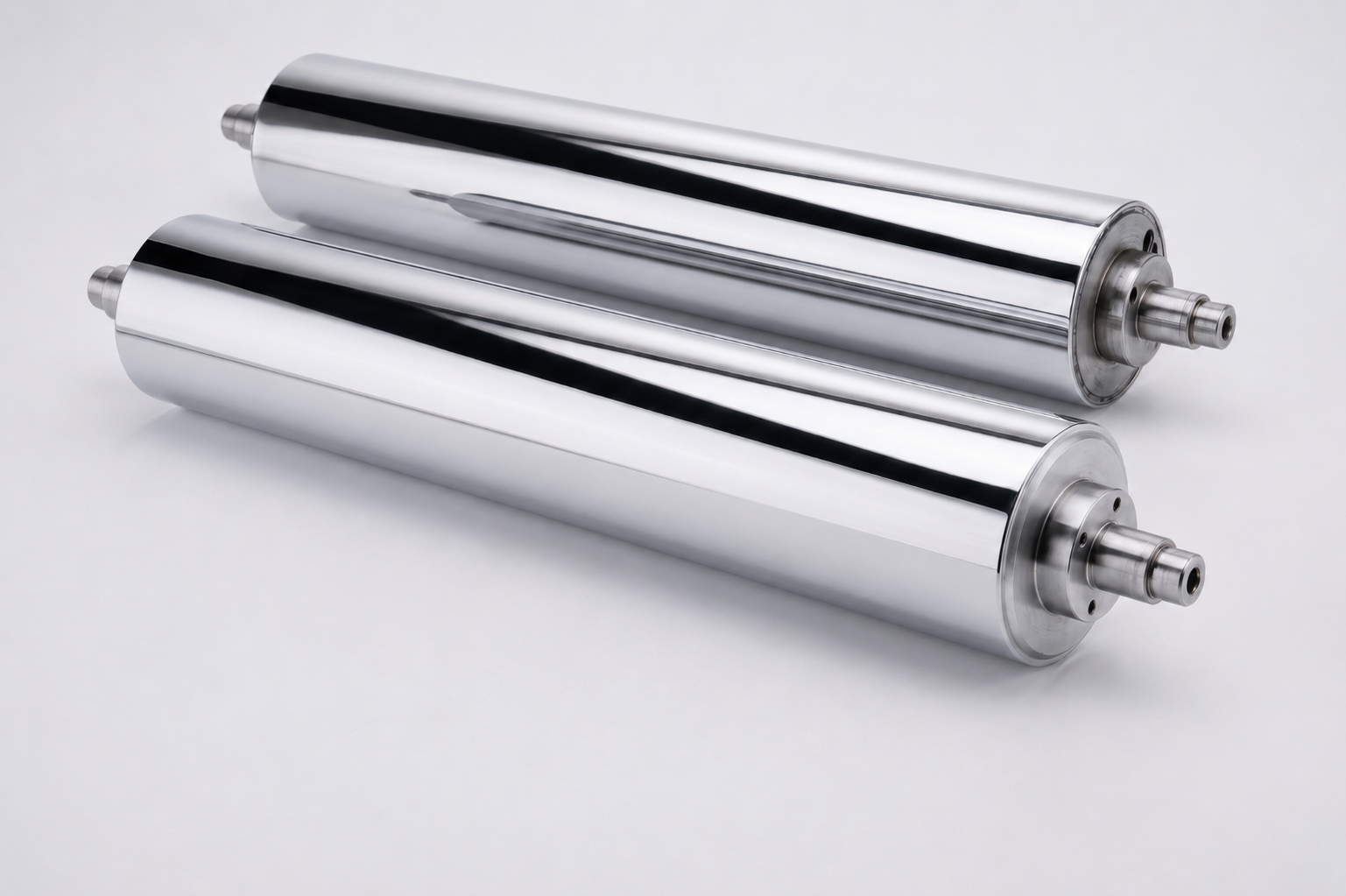
At PROEXPORT, you can order new application rollers, refurbishment of worn components, restoration of working dimensions or a new OEM replacement. We provide the agreed scope of work, from technical assessment and hard chrome plating to grinding, polishing and preparation of the finished roller for transport.
We manufacture new application rollers based on technical documentation, drawings, customer-supplied measurements or an existing roller provided as a sample.
We refurbish worn, scratched or corroded working surfaces of application rollers, provided the condition of the component allows it to continue operating after repair.
We apply hard chrome plating to metal rollers when the working surface requires improved wear resistance and restoration of its working dimensions.
After applying the coating, we perform surface finishing: precision grinding and polishing to the required surface roughness.
During the reconditioning process, we can restore the roller’s working dimensions within the range determined by the condition of the component, the documentation, and the machine’s operating requirements.
In addition to metal and chrome-plated rollers, we can provide Rilsan and rubber coatings as an additional service, tailored to the specific application.
Please send us a drawing, photos of the damage, or a description of the roller's operation—we will assess the potential scope of work.
We manufacture and recondition grinding rollers in accordance with the documentation, the condition of the supplied component, and the requirements of the specific machine. The values below show the most commonly used range for metal and chrome-plated rollers.
| The function of a roller | even distribution of paint, adhesive, varnish or other process media |
|---|---|
| Primary configurations | metal and chrome-plated rollers |
| Scope of work | manufacture of new rollers, reconditioning, technical chrome plating, grinding, polishing, and restoration of working dimensions |
| Chrome plating | most commonly 50–150 µm, depending on the documentation and the extent of dimensional reconstruction |
| Surface roughness | Ra 0.08–0.16 after finishing |
| Hard Chrome Hardness | 850–1200 HV as the appropriate range for technical chromium |
| New roller | the ability to manufacture an OEM replacement based on drawings, documentation, measurements, or an old roller |
| Refurbishment | restoring the working surface and dimensions, if the condition of the component allows for further work after repair |
| Additional coatings | Rilsan and rubber as an additional service offering, tailored to specific applications |
| Information Required for a Quotation | drawing, photos of damage, basic dimensions, description of the roller's operation, type of medium, or an old part as a reference |
We confirm final tolerances, machining scope and manufacturing parameters after reviewing the technical drawing, the condition of the roller or the supplied sample. Hard chrome hardness is specified on the HV scale.
Complete technical documentation is not always necessary for an initial assessment. The most important information is that which allows us to determine the condition of the roller, the extent of wear, the working medium, and whether it would be better to refurbish it or manufacture a new component.
The best starting point is a technical drawing or an existing component supplied as a sample. If neither is available, send photos of the roller and its damage together with the basic dimensions.
The following information is useful: diameter, working length, journal dimensions, type of medium, operating conditions, and signs of wear. This data helps assess the possible scope of reconditioning or the manufacture of a new roller.
If you know whether it involves chrome plating, grinding, polishing, a Rilsan coating, a rubber coating, or an OEM replacement—please include that in your inquiry. If you’re not sure, describe the problem and how the roller functions in the machine.
Please send a drawing, photos of the damage, basic dimensions, or the old roller as a sample.
A worn roller working surface can cause problems with the even application of paint, adhesive, varnish, or other process media. Therefore, before determining the scope of work, we assess the roller’s condition, geometry, working surface, and the feasibility of restoring its dimensions.
Restoring the smoothness and geometry of the surface helps minimize problems with uneven application of paint, adhesive, varnish, or other processing media.
Remanufacturing can eliminate the effects of wear, scratches, corrosion, or loss of smoothness, provided the condition of the roller allows it to continue operating after repair.
Technical chrome plating and machining make it possible to restore the working dimensions of a roller within a range determined based on an analysis of the documentation or the old component.
If the core, journals and geometry remain suitable for continued operation, refurbishment may be a reasonable alternative to manufacturing the entire component from scratch.
If the old roller is too worn or damaged, we can manufacture a new OEM replacement based on drawings, documentation, measurements, or a sample you provide.
Please send a drawing, photos of the damage, or the basic dimensions of the roller.
Ink distributor rollers distribute ink within printing press inking units. Surface condition, smoothness and stable roller geometry are important in this application.
Inking rollers are used to distribute ink in printing press assemblies. The condition of the surface, smoothness, and stable geometry of the roller are important factors here.
In packaging production, rollers can be used with ink, varnish, adhesive, or other media. Wear on the working surface can affect the uniformity of application.
In coating applications, the repeatability of the surface finish is crucial. Scratches, corrosion, or roller runout can affect process stability.
When working with adhesive, it is important to consider the choice of surface, dimensional accuracy, and the coating’s resistance to process conditions. To evaluate these factors, a description of the medium and the roller’s operation is required.
In paper production lines, application rollers can work with process media that require stable and uniform distribution across the surface.
Grinding rollers can also be used in chemical processes and in plastics processing if the medium requires controlled distribution across the working surface.
Describe the industry, the medium, and the operating conditions of the roller—we'll determine the possible scope of work.
Not every worn roller needs to be replaced with a new one right away. First, it’s worth assessing the condition of the working surface, the geometry, the journals, and the possibility of restoring the dimensions. Only after such an analysis can it be determined whether it would be better to recondition the roller or manufacture a new replacement.
Reconditioning makes sense when the roller's design allows for continued operation after the working surface has been restored. The process may include chrome plating, grinding, polishing, and dimensional restoration.
If the roller has lost its working dimensions, it is possible to assess whether it can be restored through coating and machining. The final scope depends on the documentation, wear, and the machine’s operational requirements.
If the old roller is too worn, damaged, or cannot be safely restored to its original geometry, a new part can be manufactured based on a drawing, measurements, documentation, or the old roller.
In one project, the customer’s existing application roller was no longer suitable for refurbishment. PROEXPORT manufactured a new chrome-plated stainless-steel roller using the documentation and measurements supplied by the customer. The component was prepared for transport in a dedicated wooden crate.
Please send a drawing, photos of the damage, or an old roller as a sample.
When ordering a new roller, having a worn part remanufactured, or having an OEM replacement made, the most common questions concern documentation, the scope of work, chromium plating, surface roughness, coatings, and the information needed for a quote.